
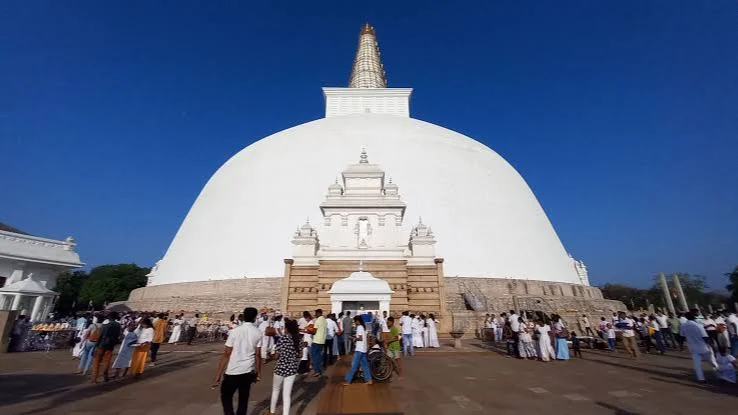
The Ruwanweli Maha Seya, also known as the Great Stupa or Mahathupa, stands at the spiritual heart of Anuradhapura, Sri Lanka. Commissioned by King Dutugemunu in the 2nd century BCE (around 140 BCE), it remains one of the ancient world’s most ambitious architectural achievements and one of Theravada Buddhism’s most sacred monuments.
Historical Origins and Conception According to the Mahavamsa, the ancient chronicle of Sri Lanka, King Dutugemunu embarked on constructing the Maha Seya after unifying the island under a single banner. He envisioned a monument capable of enshrining a large portion of the bodily relics of Gautama Buddha—traditionally stated to be one dona (a measure) of relics, making it the single largest repository of such relics on the island.
Legend recounts that the location was consecrated centuries earlier during the visit of Arahant Mahinda, who introduced Buddhism to Sri Lanka. When King Dutugemunu consulted his master builder regarding the shape of the stupa, the builder took water in a golden bowl, splashed a drop into the air, and created a bubble—proposing the classic Bubbulakara (bubble-shaped) dome that defines the monument.
Engineering and Architecture At its completion, the stupa was one of the tallest human-made structures in antiquity, standing over 300 feet (91 meters) high with a circumference exceeding 900 feet (290 meters).
The Foundation: To support the colossal weight, builders laid a multi-layered foundation of crushed stones, clay, copper sheeting, silver, and resin-bound bricks, compacted using elephants wearing leather boots.
The Relic Chamber (Dhatugarbha): The central chamber was decorated with murals and contained a jeweled Bodhi tree crafted from gold, surrounded by silver images depicting events from the life of the Buddha.
The Elephant Wall (Hasti Prakaraya): Surrounding the raised stone terrace (Salapatala Maluwa) is a outer retaining wall sculpted with hundreds of life-sized front-facing elephant figures, symbolizing that the mighty creatures shoulder the entire spiritual weight of the stupa.
Decline and 20th-Century Restoration Following foreign invasions and the eventual abandonment of Anuradhapura as a royal capital in the 11th century, the stupa fell into ruin, gradually reclaimed by thick jungle.
Its revival began in the late 19th century through the tireless efforts of the Buddhist monk Ven. Naranwita Sumanasara Thero, who initiated the clearance of the overgrowth and basic structural preservation. Modern restoration was fully completed in the 1940s, culminating in the placement of the pinnacle and a magnificent crystal (Chuda Manikya) atop the spire to catch the early dawn light.
Cultural and Spiritual Significance Today Today, Ruwanweli Maha Seya is one of the Solosmasthana (the 16 sacred pilgrimage sites of Sri Lanka) and the focal point of the Atamasthana (Eight Sacred Places of Anuradhapura). On full moon (Poya) days, thousands of devotees clad in white circumambulate the vast platform, carrying lengths of saffron and orange cloth (Kanchuka Pooja) to wrap the dome in offering. It remains an enduring emblem of ancient civil engineering, national heritage, and living Buddhist devotion.


